 Add to Chrome
 Add to Firefox
 Add to Edge
GLeVE: Graph-Guided Lesion Grounding with Proposal Verification in 3D CT
May 21, 2026
Grounding radiology report descriptions to 3D CT volumes is essential for verifiable clinical interpretation, yet remains challenging due to the semantic-spatial gap between free-text narratives and volumetric anatomy. Existing report-assisted and vision-language grounding methods typically rely on phrase-level alignment or dense pixel supervision, resulting in limited lesion-wise correspondence and suboptimal localization accuracy. We propose GLeVE, a graph-guided lesion grounding framework with anatomical prior verification and octree-based autoregressive refinement. GLeVE treats each lesion description as an atomic semantic unit and encodes organ attribution, attributes, and inter-lesion relations through relation-aware graph reasoning to produce discriminative lesion-wise queries. Anatomy-aware proposal generation with region-level verification enforces one-to-one text-lesion alignment, while hierarchical octree refinement progressively improves boundary delineation. Experiments on AbdomenAtlas 3.0 demonstrate consistent gains over classical multimodal foundation models and report-supervised baselines in both segmentation accuracy and lesion-level localization.

EReCu: Pseudo-label Evolution Fusion and Refinement with Multi-Cue Learning for Unsupervised Camouflage Detection
Mar 12, 2026Unsupervised Camouflaged Object Detection (UCOD) remains a challenging task due to the high intrinsic similarity between target objects and their surroundings, as well as the reliance on noisy pseudo-labels that hinder fine-grained texture learning. While existing refinement strategies aim to alleviate label noise, they often overlook intrinsic perceptual cues, leading to boundary overflow and structural ambiguity. In contrast, learning without pseudo-label guidance yields coarse features with significant detail loss. To address these issues, we propose a unified UCOD framework that enhances both the reliability of pseudo-labels and the fidelity of features. Our approach introduces the Multi-Cue Native Perception module, which extracts intrinsic visual priors by integrating low-level texture cues with mid-level semantics, enabling precise alignment between masks and native object information. Additionally, Pseudo-Label Evolution Fusion intelligently refines labels through teacher-student interaction and utilizes depthwise separable convolution for efficient semantic denoising. It also incorporates Spectral Tensor Attention Fusion to effectively balance semantic and structural information through compact spectral aggregation across multi-layer attention maps. Finally, Local Pseudo-Label Refinement plays a pivotal role in local detail optimization by leveraging attention diversity to restore fine textures and enhance boundary fidelity. Extensive experiments on multiple UCOD datasets demonstrate that our method achieves state-of-the-art performance, characterized by superior detail perception, robust boundary alignment, and strong generalization under complex camouflage scenarios.
FedAFD: Multimodal Federated Learning via Adversarial Fusion and Distillation
Mar 05, 2026Multimodal Federated Learning (MFL) enables clients with heterogeneous data modalities to collaboratively train models without sharing raw data, offering a privacy-preserving framework that leverages complementary cross-modal information. However, existing methods often overlook personalized client performance and struggle with modality/task discrepancies, as well as model heterogeneity. To address these challenges, we propose FedAFD, a unified MFL framework that enhances client and server learning. On the client side, we introduce a bi-level adversarial alignment strategy to align local and global representations within and across modalities, mitigating modality and task gaps. We further design a granularity-aware fusion module to integrate global knowledge into the personalized features adaptively. On the server side, to handle model heterogeneity, we propose a similarity-guided ensemble distillation mechanism that aggregates client representations on shared public data based on feature similarity and distills the fused knowledge into the global model. Extensive experiments conducted under both IID and non-IID settings demonstrate that FedAFD achieves superior performance and efficiency for both the client and the server.
SRSplat: Feed-Forward Super-Resolution Gaussian Splatting from Sparse Multi-View Images
Nov 15, 2025Feed-forward 3D reconstruction from sparse, low-resolution (LR) images is a crucial capability for real-world applications, such as autonomous driving and embodied AI. However, existing methods often fail to recover fine texture details. This limitation stems from the inherent lack of high-frequency information in LR inputs. To address this, we propose \textbf{SRSplat}, a feed-forward framework that reconstructs high-resolution 3D scenes from only a few LR views. Our main insight is to compensate for the deficiency of texture information by jointly leveraging external high-quality reference images and internal texture cues. We first construct a scene-specific reference gallery, generated for each scene using Multimodal Large Language Models (MLLMs) and diffusion models. To integrate this external information, we introduce the \textit{Reference-Guided Feature Enhancement (RGFE)} module, which aligns and fuses features from the LR input images and their reference twin image. Subsequently, we train a decoder to predict the Gaussian primitives using the multi-view fused feature obtained from \textit{RGFE}. To further refine predicted Gaussian primitives, we introduce \textit{Texture-Aware Density Control (TADC)}, which adaptively adjusts Gaussian density based on the internal texture richness of the LR inputs. Extensive experiments demonstrate that our SRSplat outperforms existing methods on various datasets, including RealEstate10K, ACID, and DTU, and exhibits strong cross-dataset and cross-resolution generalization capabilities.
A Reactive Framework for Whole-Body Motion Planning of Mobile Manipulators Combining Reinforcement Learning and SDF-Constrained Quadratic Programmi
Mar 31, 2025As an important branch of embodied artificial intelligence, mobile manipulators are increasingly applied in intelligent services, but their redundant degrees of freedom also limit efficient motion planning in cluttered environments. To address this issue, this paper proposes a hybrid learning and optimization framework for reactive whole-body motion planning of mobile manipulators. We develop the Bayesian distributional soft actor-critic (Bayes-DSAC) algorithm to improve the quality of value estimation and the convergence performance of the learning. Additionally, we introduce a quadratic programming method constrained by the signed distance field to enhance the safety of the obstacle avoidance motion. We conduct experiments and make comparison with standard benchmark. The experimental results verify that our proposed framework significantly improves the efficiency of reactive whole-body motion planning, reduces the planning time, and improves the success rate of motion planning. Additionally, the proposed reinforcement learning method ensures a rapid learning process in the whole-body planning task. The novel framework allows mobile manipulators to adapt to complex environments more safely and efficiently.
EPRecon: An Efficient Framework for Real-Time Panoptic 3D Reconstruction from Monocular Video
Sep 03, 2024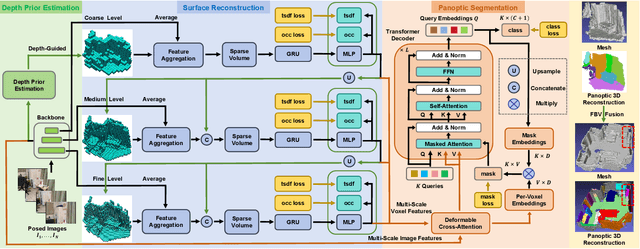
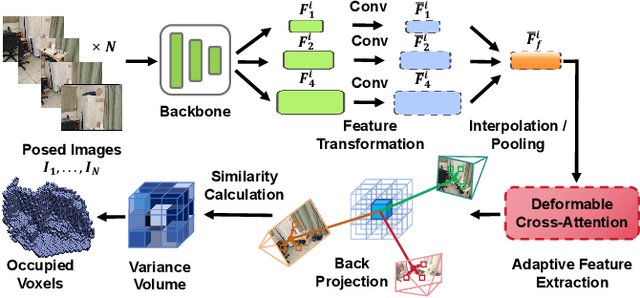
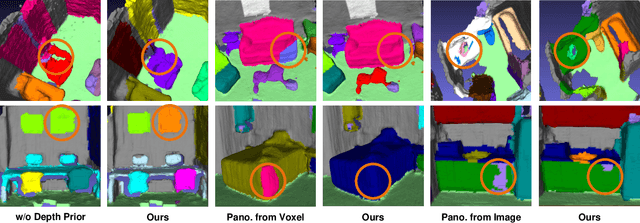

Panoptic 3D reconstruction from a monocular video is a fundamental perceptual task in robotic scene understanding. However, existing efforts suffer from inefficiency in terms of inference speed and accuracy, limiting their practical applicability. We present EPRecon, an efficient real-time panoptic 3D reconstruction framework. Current volumetric-based reconstruction methods usually utilize multi-view depth map fusion to obtain scene depth priors, which is time-consuming and poses challenges to real-time scene reconstruction. To end this, we propose a lightweight module to directly estimate scene depth priors in a 3D volume for reconstruction quality improvement by generating occupancy probabilities of all voxels. In addition, to infer richer panoptic features from occupied voxels, EPRecon extracts panoptic features from both voxel features and corresponding image features, obtaining more detailed and comprehensive instance-level semantic information and achieving more accurate segmentation results. Experimental results on the ScanNetV2 dataset demonstrate the superiority of EPRecon over current state-of-the-art methods in terms of both panoptic 3D reconstruction quality and real-time inference. Code is available at https://github.com/zhen6618/EPRecon.
High-Linearity PAM-4 Silicon Micro-ring Transmitter Architecture with Electronic-Photonic Hybrid DAC
Apr 14, 2024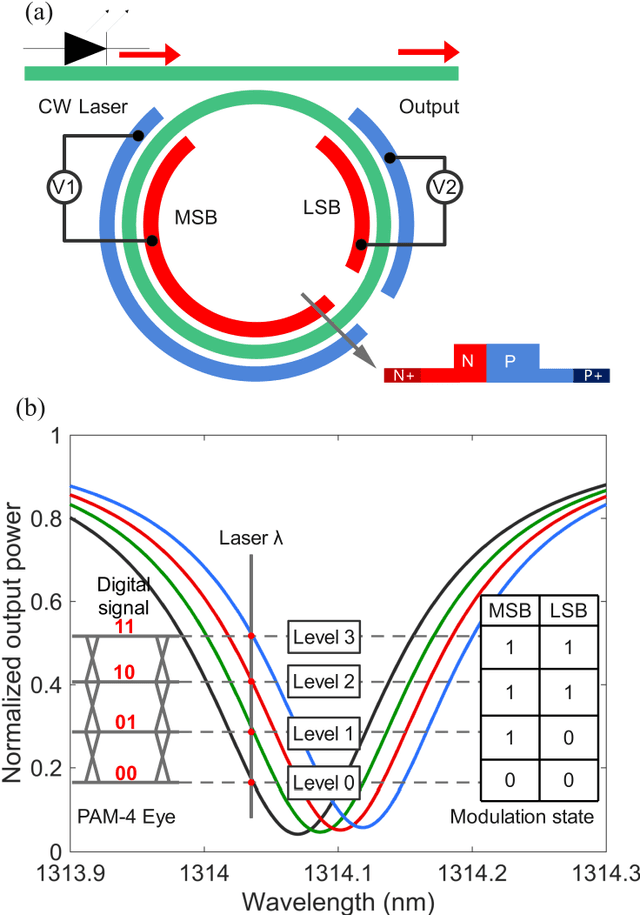
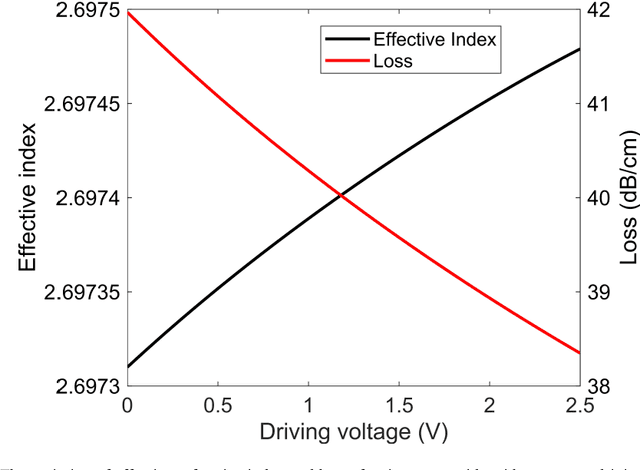

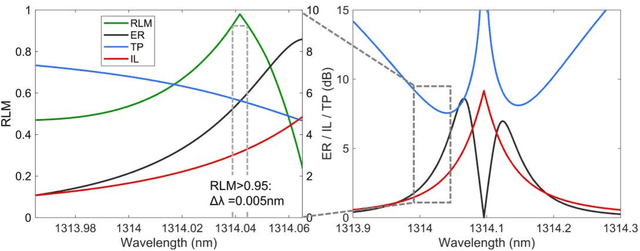
This paper presents a high linearity PAM-4 transmitter (TX) architecture, consisting of a three-segment micro-ring modulator (MRM) and a matched CMOS driver. This architecture can drive a high-linearity 4-level pulse amplitude (PAM-4) modulation signal, thereby extending the tunable operating wavelength range for achieving linear PAM-4 output. We use the three-segment MRM to increase design flexibility so that the linearity of PAM-4 output can be optimized with another degree of freedom. Each phase shift region is directly driven by the independently amplitude-tunable Non-Return-to-Zero (NRZ) signal. The three-segment modulator can achieve an adjustable wavelength range of approximately 0.037 nm within the high linearity PAM-4 output limit when the driving voltage varies from 1.5 V to 3 V, simultaneously achieving an adjustable insertion loss (IL) range of approximately 2 dB, roughly four times that of the two-segment MRM with a similar design. The driver circuit with adjustable driving voltage is co-designed to adjust the eye height to improve PAM-4 linearity. In this article, the high linearity PAM-4 silicon micro-ring architecture can be employed in optical transmitters to adjust PAM-4 eye-opening size and maximize the PAM-4 output linearity, thus offering the potential for high-performance and low-power overhead transmitters.
Completely Occluded and Dense Object Instance Segmentation Using Box Prompt-Based Segmentation Foundation Models
Jan 16, 2024Completely occluded and dense object instance segmentation (IS) is an important and challenging task. Although current amodal IS methods can predict invisible regions of occluded objects, they are difficult to directly predict completely occluded objects. For dense object IS, existing box-based methods are overly dependent on the performance of bounding box detection. In this paper, we propose CFNet, a coarse-to-fine IS framework for completely occluded and dense objects, which is based on box prompt-based segmentation foundation models (BSMs). Specifically, CFNet first detects oriented bounding boxes (OBBs) to distinguish instances and provide coarse localization information. Then, it predicts OBB prompt-related masks for fine segmentation. To predict completely occluded object instances, CFNet performs IS on occluders and utilizes prior geometric properties, which overcomes the difficulty of directly predicting completely occluded object instances. Furthermore, based on BSMs, CFNet reduces the dependence on bounding box detection performance, improving dense object IS performance. Moreover, we propose a novel OBB prompt encoder for BSMs. To make CFNet more lightweight, we perform knowledge distillation on it and introduce a Gaussian smoothing method for teacher targets. Experimental results demonstrate that CFNet achieves the best performance on both industrial and publicly available datasets.
Linear Gaussian Bounding Box Representation and Ring-Shaped Rotated Convolution for Oriented Object Detection
Nov 14, 2023In oriented object detection, current representations of oriented bounding boxes (OBBs) often suffer from boundary discontinuity problem. Methods of designing continuous regression losses do not essentially solve this problem. Although Gaussian bounding box (GBB) representation avoids this problem, directly regressing GBB is susceptible to numerical instability. We propose linear GBB (LGBB), a novel OBB representation. By linearly transforming the elements of GBB, LGBB avoids the boundary discontinuity problem and has high numerical stability. In addition, existing convolution-based rotation-sensitive feature extraction methods only have local receptive fields, resulting in slow feature aggregation. We propose ring-shaped rotated convolution (RRC), which adaptively rotates feature maps to arbitrary orientations to extract rotation-sensitive features under a ring-shaped receptive field, rapidly aggregating features and contextual information. Experimental results demonstrate that LGBB and RRC achieve state-of-the-art performance. Furthermore, integrating LGBB and RRC into various models effectively improves detection accuracy.
RegHEC: Hand-Eye Calibration via Simultaneous Multi-view Point Clouds Registration of Arbitrary Object
Apr 27, 2023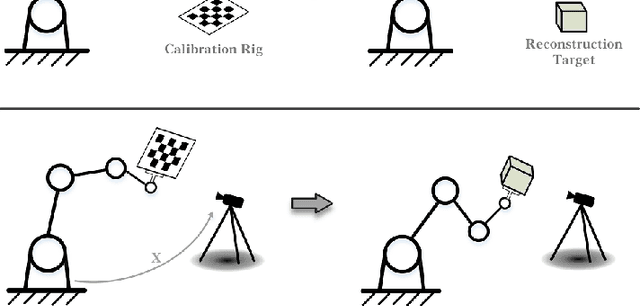

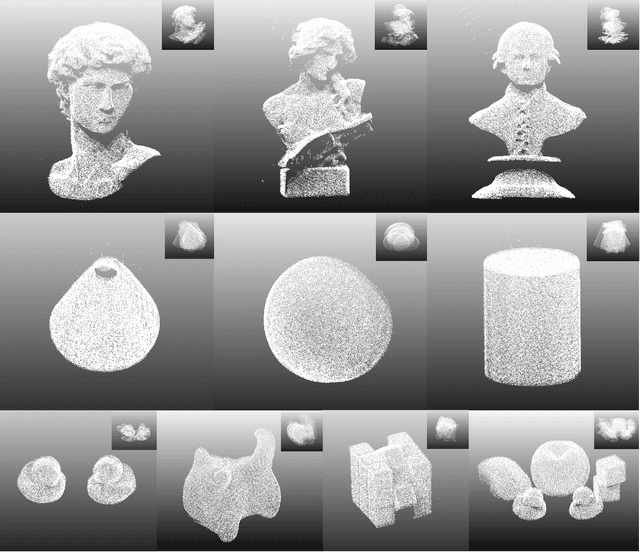

RegHEC is a registration-based hand-eye calibration technique with no need for accurate calibration rig but arbitrary available objects, applicable for both eye-in-hand and eye-to-hand cases. It tries to find the hand-eye relation which brings multi-view point clouds of arbitrary scene into simultaneous registration under a common reference frame. RegHEC first achieves initial alignment of multi-view point clouds via Bayesian optimization, where registration problem is modeled as a Gaussian process over hand-eye relation and the covariance function is modified to be compatible with distance metric in 3-D motion space SE(3), then passes the initial guess of hand-eye relation to an Anderson Accelerated ICP variant for later fine registration and accurate calibration. RegHEC has little requirement on calibration object, it is applicable with sphere, cone, cylinder and even simple plane, which can be quite challenging for correct point cloud registration and sensor motion estimation using existing methods. While suitable for most 3-D vision guided tasks, RegHEC is especially favorable for robotic 3-D reconstruction, as calibration and multi-view point clouds registration of reconstruction target are unified into a single process. Our technique is verified with extensive experiments using varieties of arbitrary objects and real hand-eye system. We release an open-source C++ implementation of RegHEC.